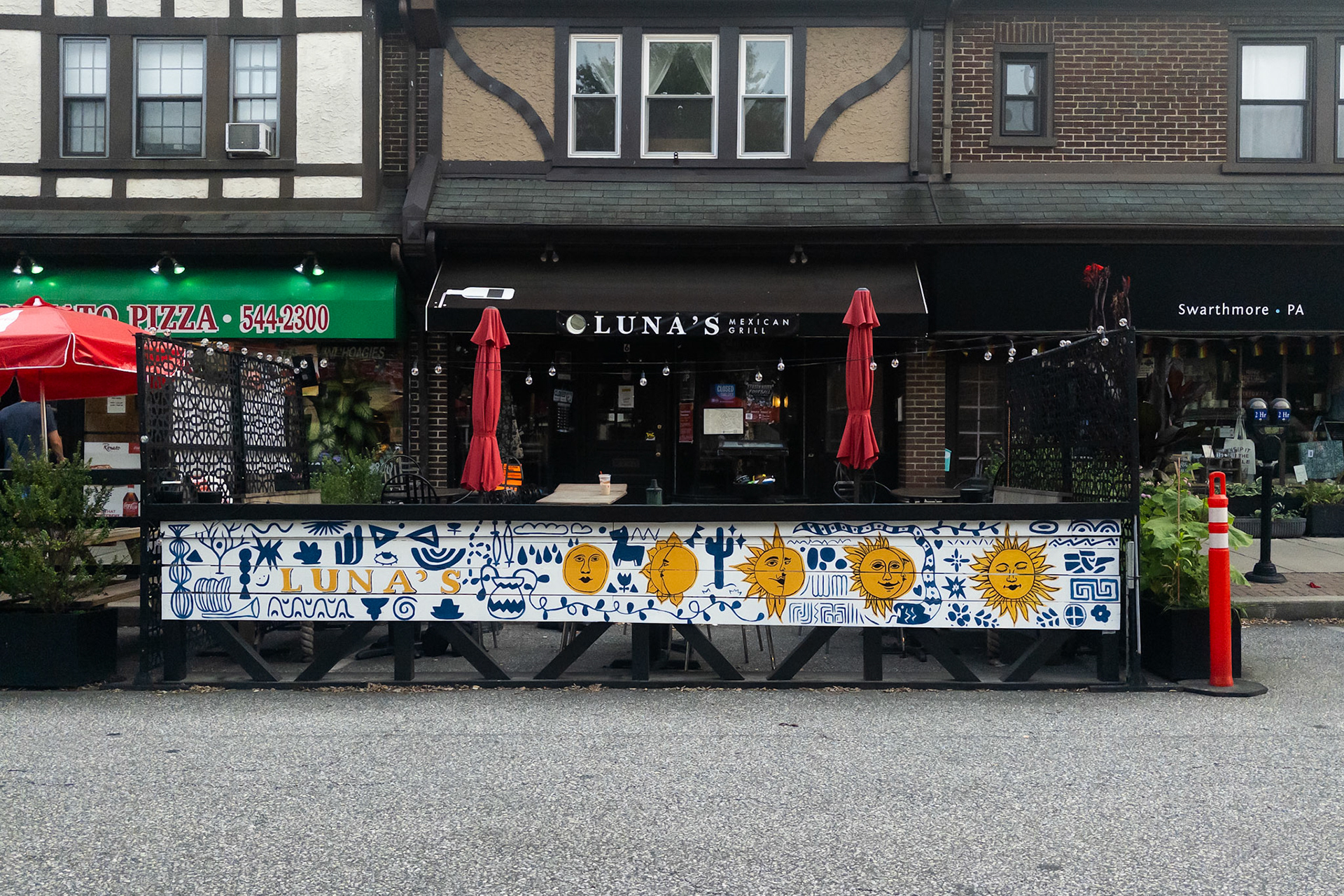
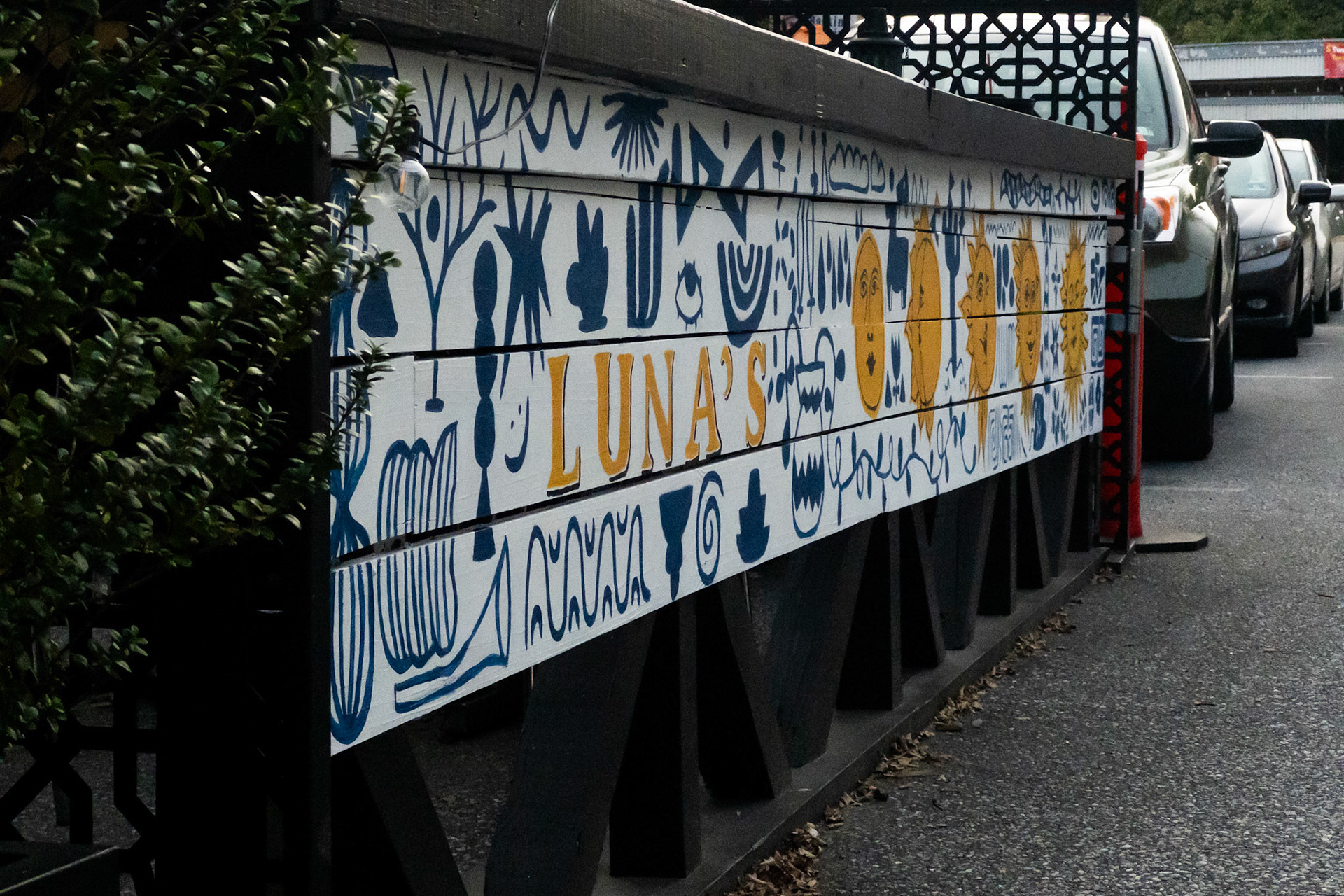
I was sick of the brown wall on Park Ave. So I put art on it.

One Step Back
After my mother acquired the 6 Park Ave commercial space in Swarthmore, PA, to open her lifelong dream restaurant, Luna’s Mexican Grill, the deal included a parklet/patio that sat in the middle of Park Ave.
The previous restaurant owner used the outside space as additional seating, especially during the pandemic, when having a lot of space became a competitive advantage for seating as many customers as possible while social distancing rules were still in place.
Of course, we used this space and kept the parklet for seating, but something was missing.
Why?
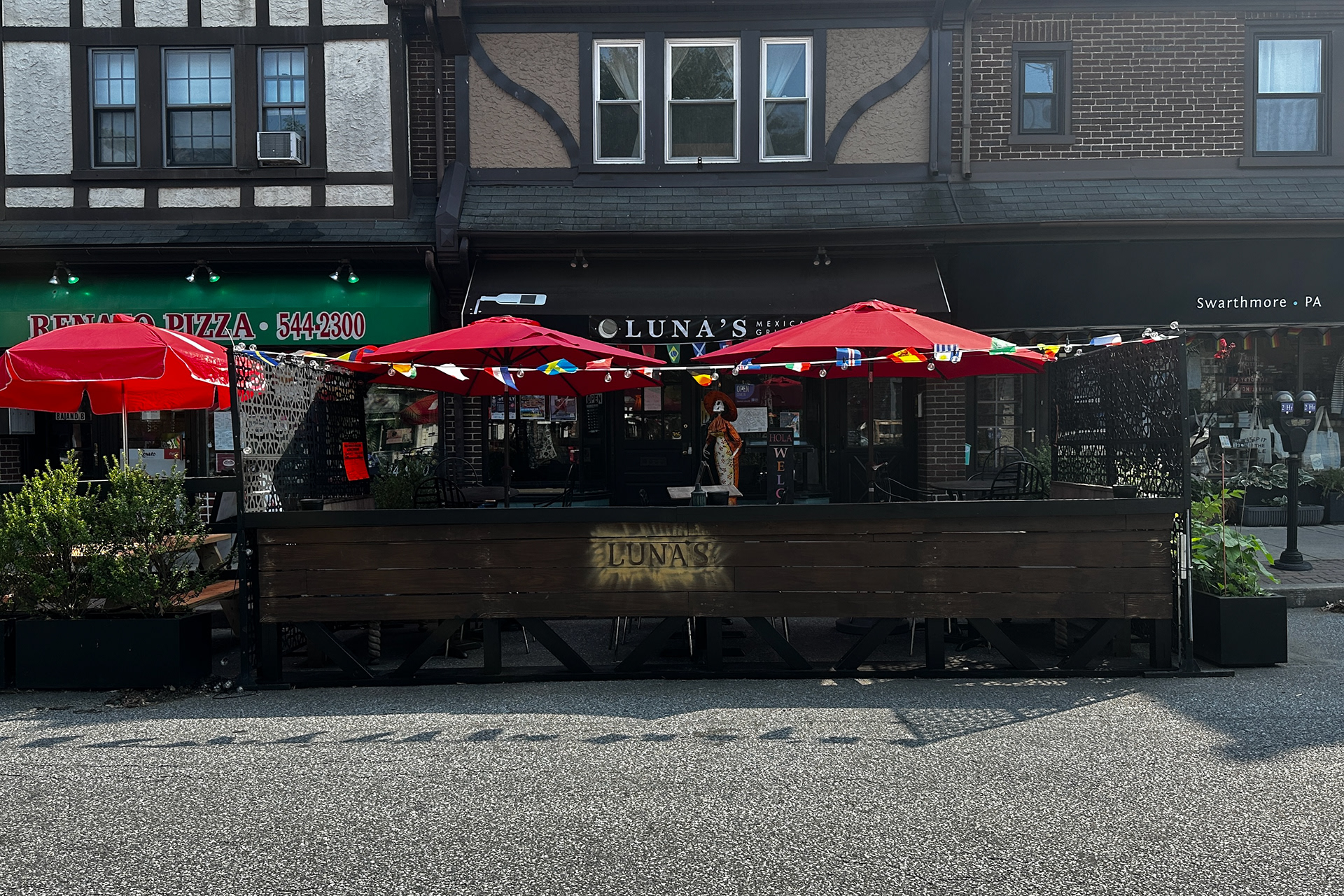
Imagine how miserable and boring it is to look at this while having a stroll down the street. Gross.
On the opposite side of where the customers sit was a large brown wooden barricade that partitioned the street from the dining area. It was nothing but bland, boring, and an eyesore on Park Ave. Say, even if you were sitting in the yards adjacent to the brewery, glance across the street; it's just this big brown obstruction.
Something had to be done. I went to work.
The Swarthmore community is nothing short of strong and supportive of its creatives and its art. A mural made the most sense to me to revive this space.
I started planning and drafting up ideas in July of 2025, only months after Luna’s opened. I really was not a fan of the brown wall. But because I am still young, school started again, and I just shelved the project.
Come around summer 2026, I had more time on my hands than I really knew what to do with, so I decided to give an art piece to my community as a legacy project, shortly before I left to start college.
This was no ordinary art project. I was not commissioned by anyone; it was just something I wanted to do. I was thankful to have the support from my mother, who also provided me with resources and time for this to be successful.
Inspiration
My inspiration came from the natural human forms and complex symbolism of Mayan hieroglyphs, but I also knew I wanted something unique, so I combined various doodles and icons that I thought were significant.
I chose blue as the primary color of the main graphics, reminiscent of traditional Spanish ceramic pottery known as ‘Fajalauza.’ This style of pottery represents the everyday life of regular objects, including food. (Plus, it just looks good, and I wanted the whole piece to stand out)
At the core of the project, it also features the Latin moon (luna) and sun (sol) in an eclipse to fully reveal the power of the sun, representing life, energy, strength, and the continuous cycle of time and creation.
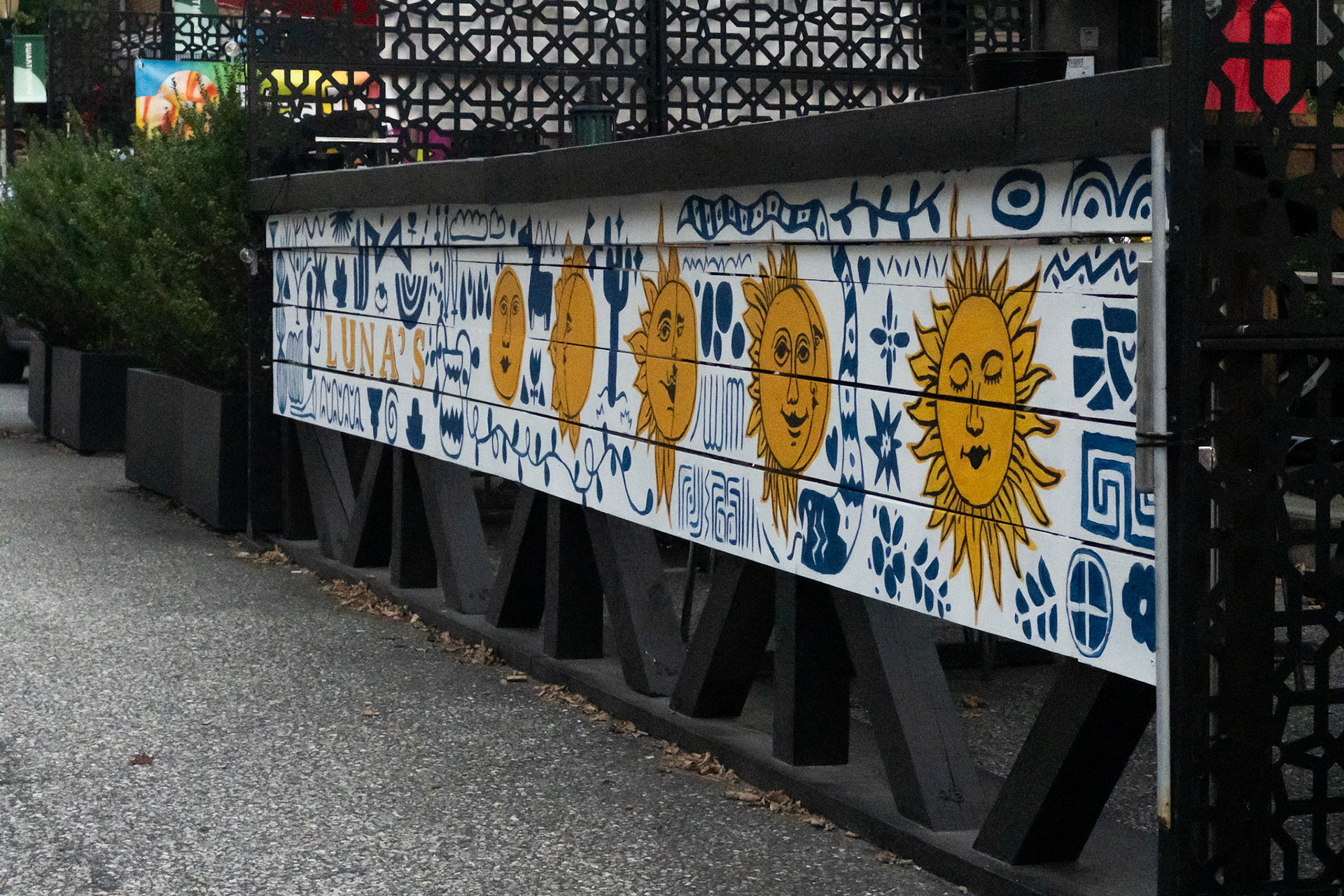
Closer image of the sun/moon details.
The Process
After measuring the short wall, I rendered a scale version on Procreate, complete with where the different panels of wood meet, start, and connect. This also included the smaller panels that are ‘wedged’ between the larger pieces because Park Ave is not level, but the wall is!
After sketching the design in Procreate, I took it over to Photoshop where I spliced the file into 17 separate ‘panels’ that I could reference when sketching the design in real life. The wall is 17 feet long, so I divided the work into 17 different parts (1 foot per section in width)
I started with multiple layers of white matte acrylic on the wall first, just so that the brown would finally go away. I then measured one foot each out of the wall so that my reference would match the sections I would finally sketch on the wall. (The digital version was about 4 inches too long, so some compromise was needed, but it all worked out.)
Now, sketching the design was as simple as using the grid method. This allowed me to accurately relay the digital design onto the wall with correct proportions. This was especially important when planning the letters that read ‘LUNA’S’ and for the complicated moon/sun designs.
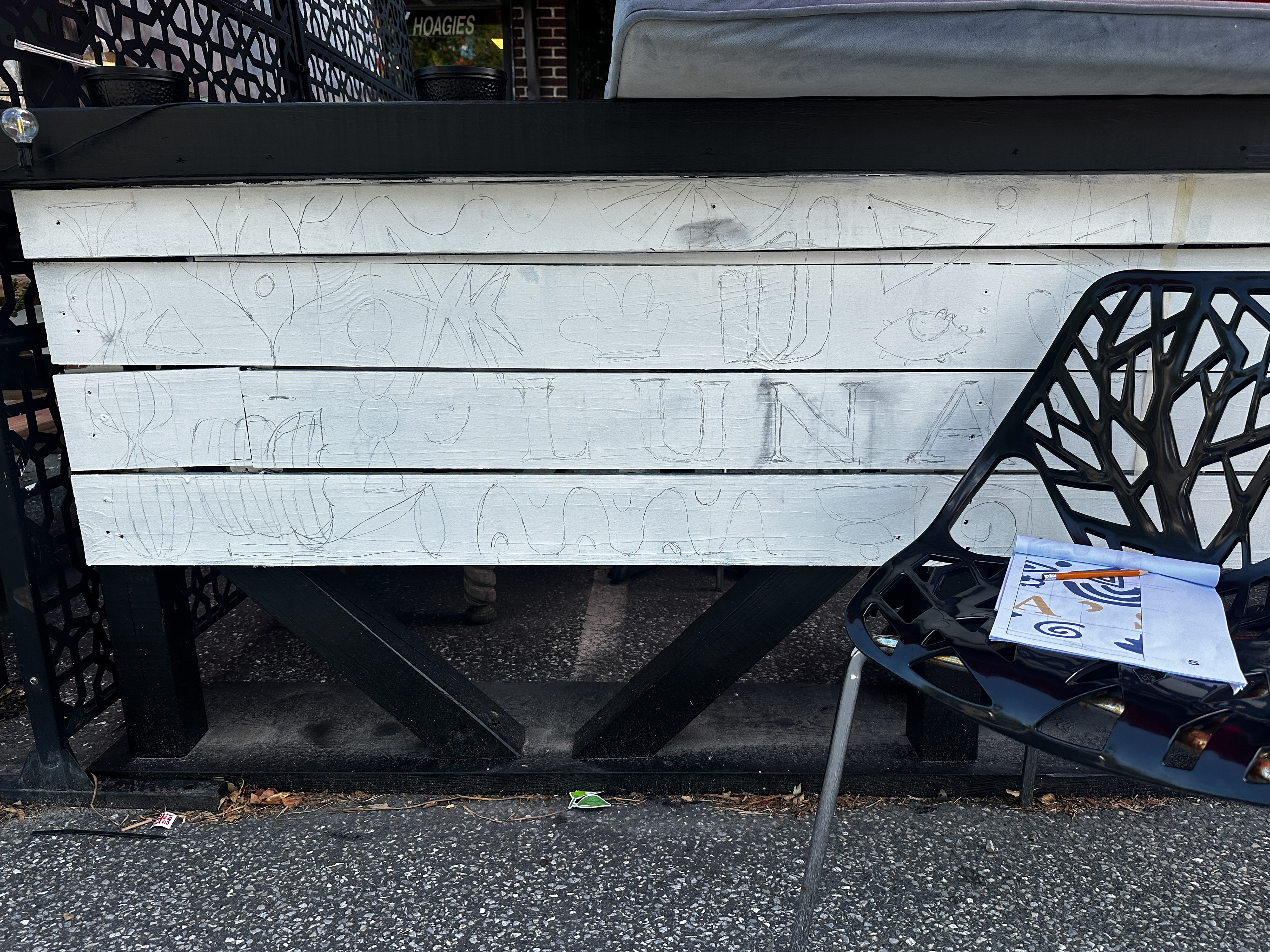
Notice the sheets of paper sitting on the chair. I had 17 different 'sections' that I was referencing when putting the sketches on the wall.
After the sketches were done, I then went in with the blue paint, tracing over the graphite. I used a thinner paint brush to make sure the line thickness of the designs was consistent. I had to do 2 layers of blue on the design because the paint was rather thin and you could see the strokes and graphite on only one layer of paint.
Details are everything. After the blue, I then went back to touch up the blue paint that may have bled over sections they shouldn't have, and to also hide mistakes from the graphite sketches. (Thanks to mom for helping me out on this part!)
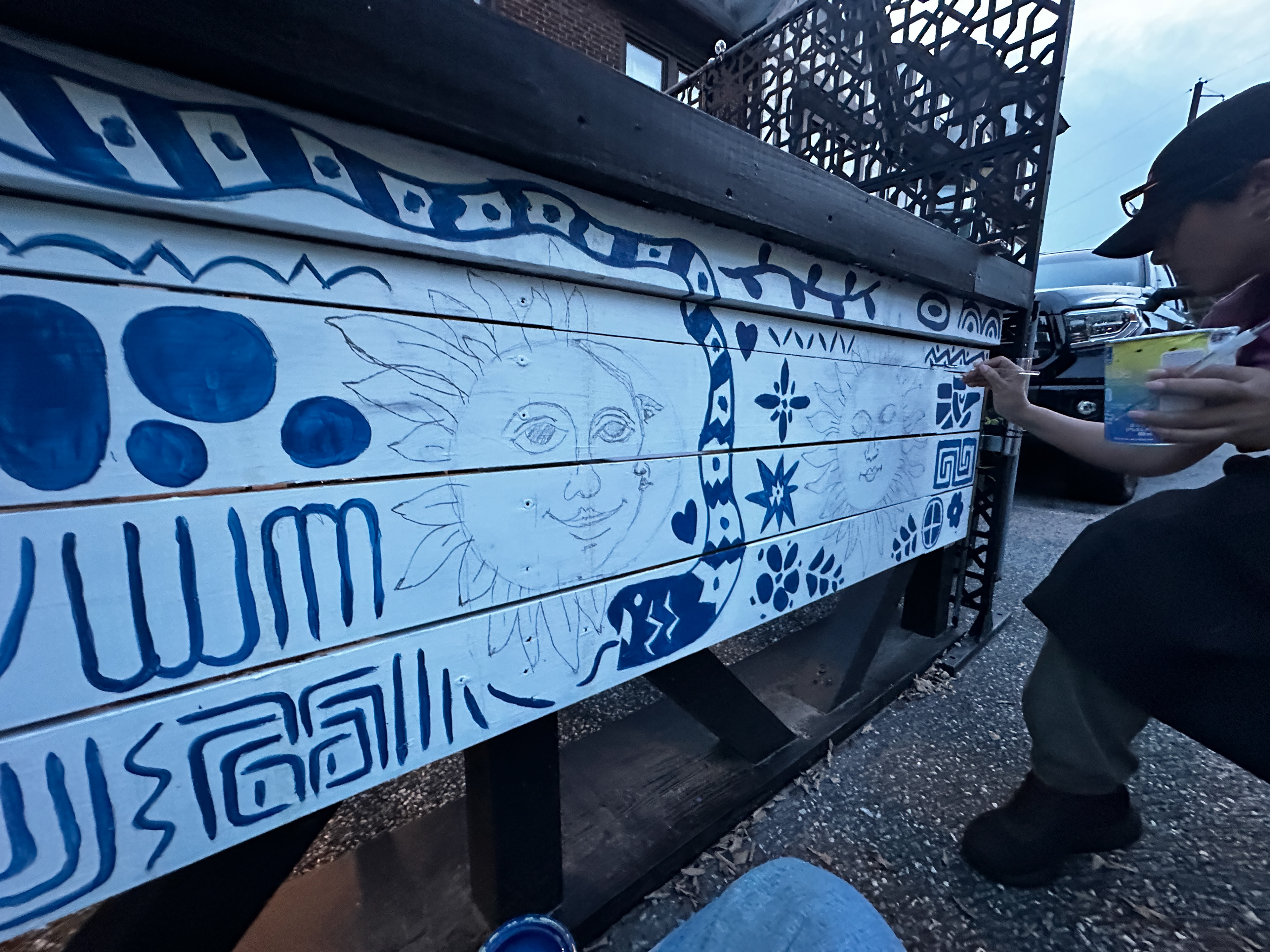
One layer of the blue paint was only so effective. Much of the time spent here was layering so that the color contrasts really nicely with the bright white base. (Shoutout to Mom for helping with some of the details!)
Next were the sun and moons. Similar to the blue, I painted over the graphite with the yellow/gold paint. I filled in the lettering and sun flame details with care. I had originally planned to just do an outline of the sun/moons with the yellow paint, but I feared they wouldn’t stand out as much as I wanted to, so I opted to ‘fill in’ the space with the yellow paint; then I went back with black paint for all the smaller details like the face features and outlines.
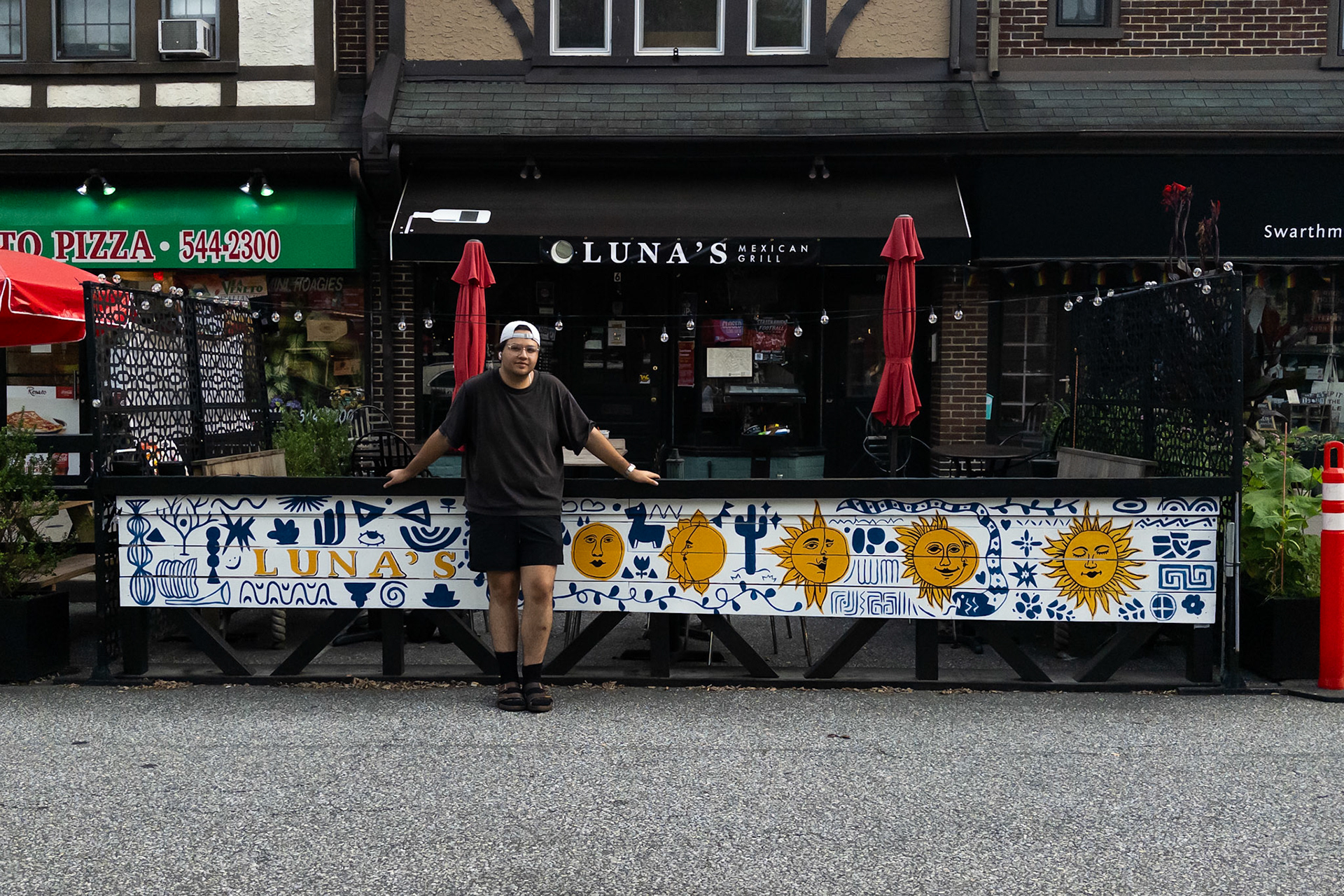
Me posed with the project shortly after completion. Aug. 14.
And now for a small shower thought... because the world needs more art, and how the mural project translates to the world of business where humanity is needed the most.
How small restaurants are the anti-AI institutions in a world of automation and efficiency
BY MATTHEW RAMIREZ
AUG. 22, 2026
In March of 2025, my mother took the leap to open and operate a small restaurant business, Luna’s Mexican Grill, her lifelong dream. Since then, I have been by her side, exposed to the daily operations, long-term management, and constantly thinking of new ways to innovate as a small business.
I’ve also helped work in almost every role in the store, from being on the line, bartending, managing the expo, and of course, being on the floor, one-on-one with our customer base.
Firsthand, I’ve seen the importance of small businesses and how they shape community culture, especially in a modern world where AI, automation, and efficiency have seemed to be the top priority in running businesses.
Large restaurant chains often want consistency, speed, predictability, and standardized measures to be successful, but a smaller business can thrive because it offers personality, flexibility, relationships, imperfection, and adaptation.
Think of large restaurant businesses like The Cheesecake Factory or Texas Roadhouse; their operations seem to be completely ironed out and effective. They have integrated top-down systems that prioritize productivity and business.
These businesses sell reliability. Their standardization is a part of why these businesses are so successful. People go to these businesses because they know what experience to expect. But small businesses often sell individuality. Each visit can be different every time. Neither is necessarily better – they are different products, and that's not necessarily a terrible thing.
Small restaurant businesses offer human nature, something that is needed in today's world. It's the small community feeling, inclusion, personalized experience, and personal bonds that make small businesses so special. It's the clientele that crave this feeling that props up small business America.
Restaurant businesses are not easy businesses to run. They run on razor-thin profit margins and face changing trends that affect everyday operations. Small businesses are under more pressure to become more efficient, but their competitive advantage is often their lack of efficiency.
The things that make a small restaurant less efficient can make it more valuable.
In most professional use cases of AI, it is used to ‘leverage’ existing human skills to increase efficiency, profits, and productivity. In the business world, this is not necessarily a terrible thing. But in a restaurant, AI can not be the thing that makes a restaurant worth visiting. Humans make the restaurant.
AI can exist in a restaurant. They use sophisticated POS systems, automated inventories, scheduling software, online ordering, and marketing, which can sometimes be unfortunate with AI slop posters for social media posts.
Nonetheless, AI just makes sure nothing operational gets in its way, but it can't replicate the reason people choose to experience the business.
Small restaurants are anti-AI not because they can not use AI or don't have the ability to; it's because the greatest value that these businesses have comes from the things that AI and automation struggle to do.
The entire small restaurant exchange is all personal. This starts from the moment people walk through the door. Only humans can offer a warm welcome and greeting. Only humans can analyze and read the room and socially adapt to match the environment of the customer.
AI can't recognize an exciting girls' night out or an anniversary dinner and how to adapt in that scenario. It can't recognize a table that wants to quietly celebrate or a party that wants all the attention.
A server doesn't talk to a group of teenagers, an elderly couple, or a regular customer the exact same way. A computer can be programmed with different responses, but humans can make judgments on which response is the most appropriate. The only computer that can recognize human nature is the human brain.
The customer has to make decisions on what they want to eat by reading options off a menu that someone else thinks is worth serving. That's much different than an algorithm choosing what you should eat or drink. Restaurants are all curated for human interaction.
Modern business culture is obsessed with consistency, efficiency, and optimization. Restaurants are the antithesis of this. None of the processes are perfect because imperfection and mistakes are unavoidable. Not every dish that leaves the kitchen expo, prepared by many of the prep, line, and kitchen staff, is perfect or the same.
Think about the staff as well. There could be a bartender who remembers your drink, when the chef makes exceptions for a regular, or the server who is familiar with all the regulars. Restaurants and hospitality are the opposite of manufacturing. This is why people are irreplaceable in supporting a memorable and exciting visit for others.
There are specific tasks that can and honestly should be AI-assisted and automated. For example, the tedious processes of taking inventory, analyzing data, or even running payroll, an AI might be more fit to assist there. This gives an opportunity for employees and management to have more time to interact with customers – the part that should remain human.
For example, every Sunday we have a customer who is at the door every morning at 9 a.m. that orders the same two items. Black coffee and a set of egg and chorizo breakfast tacos. This whole exchange is human and non-transactional, such that even once, the kitchen staff had already prepared his order when he got to the table. How could an algorithm replicate the relationship and humanity in all of this?
But small restaurants that lack technological sophistication aren't a weakness. There's a cultural value that speaks when everything isn't completely optimized. Not everything needs to be optimized.
We have become obsessed with making everything faster, easier, cheaper, and more efficient, but hospitality and the service industry can be one of the places where inefficiency can be valuable.
Being in a restaurant is supposed to take time. People sit, talk, eat, linger, and celebrate. They spend more time than they sometimes need to, and that's the opposite of modern optimization culture.
It's this paradox that is why I find this argument so interesting.
I've seen how customers become regulars just because of the personalized experience they have at my mother's restaurant. I’ve seen how my mother runs the business around the people, and I’ve seen how, because of that, the restaurant has become a part of the community.
AI has a place in running a restaurant business, but it just can't replace the part that humans have. Do we want hospitality and service to be performed by machines?
still thinking about this,
MR